Analysis of official documentation, with no testing on a paid account.
In this guide
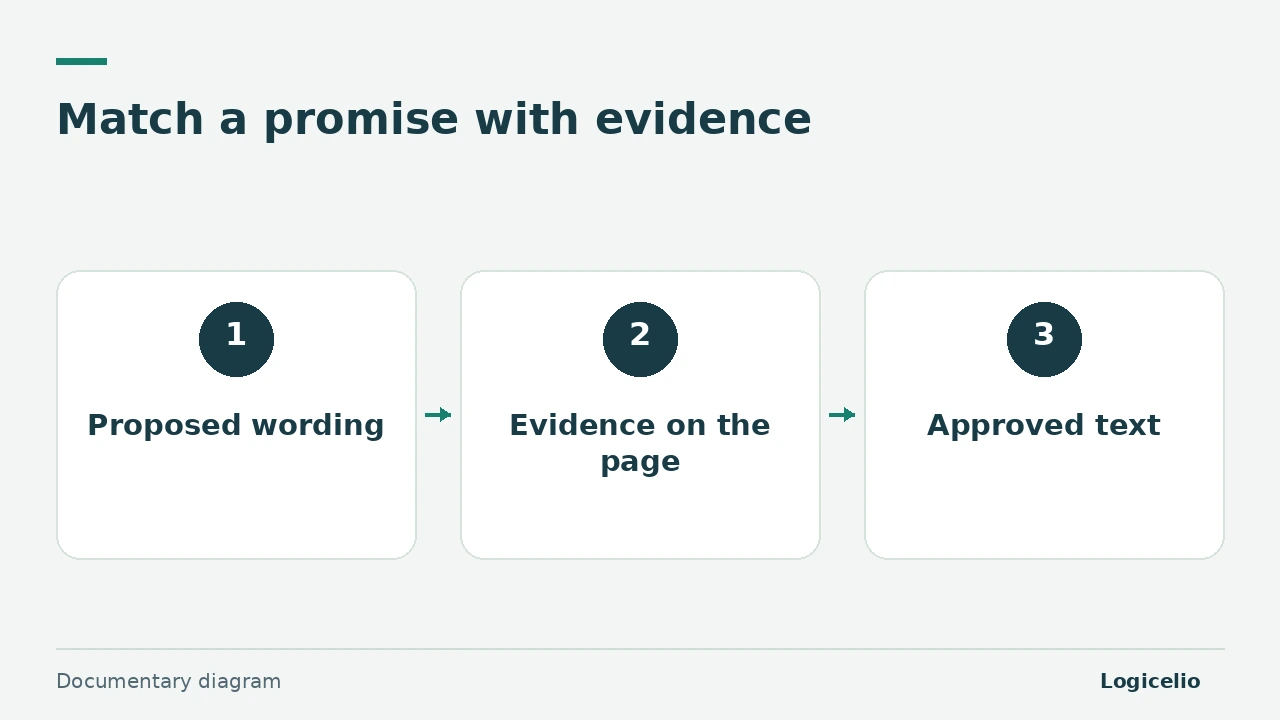
An AI-written title or description should remain an editorial suggestion. Before saving it, check every stated price, availability claim, duration and outcome against facts actually present on the page.
Method. Google Search Central documentation reviewed on 9 November 2026 and three corrections applied to a fictional offer. No AI tool, search result or SEO gain was tested.
Start with facts visible on the page
In the fictional example, the page describes a two-hour remote CRM workshop. Pricing is provided by quotation, appointments take place Monday to Friday, and a report is delivered after needs have been confirmed. These four facts set the limit of what the title and description can claim.
Start by collecting facts from the published content, offer terms and structural elements such as the main heading. A prompt given to the generator does not replace evidence available to the reader.
Correct three claims that cannot be proved
| Generated suggestion | Problem | Evidence-based correction |
|---|---|---|
| “CRM workshop for €99” | The page gives no fixed price. | “Remote CRM workshop: goals and quotation” |
| “Support available 24 h/24” | The page states that appointments take place Monday to Friday. | “Prepare your CRM workshop from Monday to Friday” |
| “Double your sales in seven days” | No sales outcome or time frame of this kind is demonstrated. | “Review your quotation follow-up in a two-hour workshop” |
The correction keeps the text commercially useful without turning an assumption into a fact. If important information is missing from the page, first add verifiable evidence to the content or remove the claim.
Check what Google may actually display
Google explains that title-link generation is automated and may use several signals, including the title, main heading, visible content and links. Text entered in the CMS therefore influences the display without guaranteeing it.
For the snippet, Google primarily uses page content and may use the meta description when it describes the page better. The snippet may vary by query. A length saved in the CMS does not guarantee a displayed length.
- Check that the
title, main heading, meta description and page body describe the same offer. - Open the page that is actually served and check its HTML instead of relying only on the CMS field.
- Privately retain the old text, new text, date and evidence used for each correction.
This record makes it possible to review the decision later. It proves neither a change in Google display nor an increase in ranking or traffic. The guide to visible pages with no clicks helps choose a diagnosis before changing text; the selection of SEO tools for small businesses places this check in a broader process.
Sources and method of this analysis
Google Search Central: title links ; Google Search Central: snippets and meta descriptions Documentary review of two Google Search Central pages and three corrections to a fictional offer. No AI tool, search result or SEO gain was tested. Sources reviewed on 9 November 2026. Methodology · Trade transparency · Report correction.