Since 1 September 2026, all companies subject to the relevant VAT must be capable of receiving electronic invoices. Large and medium-sized enterprises also have to issue them since that date, while SMEs and micro-enterprises are required to issue them at the time of issue. 1 September 2027.
The reform does not involve replacing paper with a PDF. It changes the transmission circuit, the data contained in the invoice and the role of the software used by the company. This guide gathers the important without replacing the analysis of your situation with your accountant.
In this guide
- Who is involved in the mandatory electronic invoice?
- electronic invoicing 2026-2027 Calendar
- How does the electronic invoice work?
- Formats : Invoice-X, UBL and CII
- What data become important on invoices?
- E-reporting: non-e-invoice operations
- Penalties: what the system provides
- How to choose your approved platform?
What is an electronic invoice?
An electronic invoice is an invoice issued, transmitted and received in a form containing structured data, in the reform circuit and via an approved platform. A simple PDF sent by email is therefore not, on its own, an electronic invoice conforming to the new device.
Analysis of official documentation, with no testing on a paid account.
The decisive point is the presence of data that systems can read and process automatically. The objective is not only to view an invoice on the screen, but to enable it to be routed, controlled and transmitted to the administration.
What is not an electronic invoice
A classic PDF attached to an email, a scanned paper invoice or a Word document exported in PDF remain digital documents. They do not automatically meet the requirements of the new electronic invoicing circuit.
Electronic billing, dematerialization and e-reporting
| Notion | What she calls |
|---|---|
| Dematerialization | The transition from paper to digital processing. |
| Electronic invoice | A B2B invoice entering the new regulated circuit with structured data. |
| E-reporting | The transmission to the administration of data for certain operations that do not go through conventional e-invoicing. |
Who is involved in the mandatory electronic invoice?
The reform concerns those subject to the VAT established in France, whether or not they are liable for the VAT. The DGFiP explicitly states that basic duty-free professionals, micro-entrepreneurs and self-entrepreneurs are within the scope of the scheme.
For a small structure, two subjects must be distinguished. The receipt is already to be organised since September 2026, while theIssue becomes mandatory in September 2027 for SMEs and micro-enterprises.
French B2B operations
The e-invoicing device refers to transactions entering the field between taxable persons established in France. The supplier issues via an approved platform, then the invoice is routed to the reception platform chosen by the customer.
What is more a matter of e-reporting
Sales to individuals and some international transactions do not necessarily follow the same B2B e-invoicing route. They may be subject to electronic reporting of transaction data and, in some cases, payment data.
Micro-entrepreneur and franchise based on VAT
The basic franchise does not automatically leave a reform professional. The Official DGFiP FAQ on micro-entrepreneurs recalls that a non-debtable taxable person remains concerned, at least for reception, and that he also enters into the obligation to issue according to the timetable applicable to his size.
Approved platform and management software
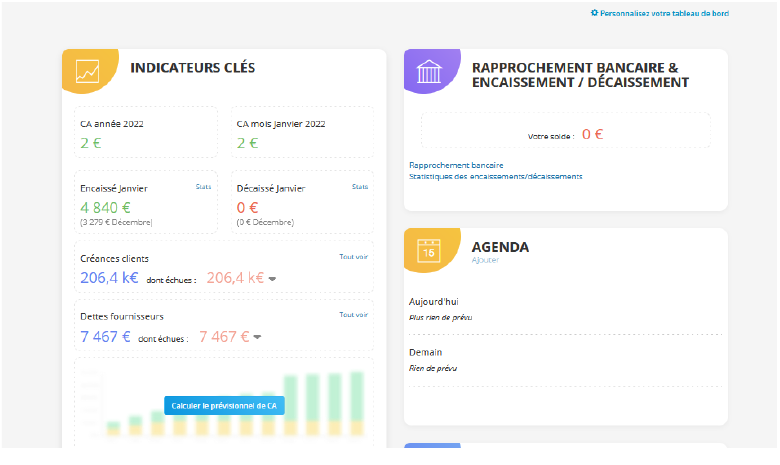
Axonaut : electronic invoicing integrated into management
Axonaut brings together billing, CRM, cash and accounting access. The vendor indicates that its approved platform function is included in the subscription.
Axonaut: 1 free month after the first purchase →Partner link
electronic invoicing 2026-2027 Calendar
Timeline for reform
All companies concerned: reception. Large companies and ITEs: Issue and e-reporting.
SMEs and micro-enterprises: issue and e-reporting according to their situation.
| Category | Reception | Issue |
|---|---|---|
| Large enterprise | 1 September 2026 | 1 September 2026 |
| ETI | 1 September 2026 | 1 September 2026 |
| SMEs | 1 September 2026 | 1 September 2027 |
| French micro-enterprise | 1 September 2026 | 1 September 2027 |
The size therefore does not change the requirement for receipt. In particular, it determines when the company must switch to the electronic issue and the corresponding e-reporting.
How does the electronic invoice work?
The system is based on approved platforms registered by the tax administration. DGFiP states that they ensure the issuance, transmission and receipt of invoices, as well as the reporting of the data foreseen by the reform.
A company may retain a so-called compatible business solution, but this solution does not replace the approved platform if it is not itself registered. The actual connection between your software and a PA is therefore more important than simply displaying a commercial badge.
Actors: approved platform and public billing portal
The public invoicing portal, or PPF, has been refocused on two functions: the directory used to route invoices and the hub for data sent to the authorities. It is no longer the free invoice-issuing portal many businesses envisaged at the start of the project.
The circuit of a five-step invoice
The supplier creates the invoice.
The PA processes format and routing.
The consignee and its receiving address shall be identified.
The client receives in his environment.
The planned data shall be transmitted to the administration.
Life cycle
An invoice may then pass through several statutes during processing. To avoid mixing technical, regulatory and optional statutes, Logicelio does not reproduce a fixed list here: the details must be read in the current specifications of DGFiP and AFNOR.
Accredited Platform or Compatible Solution: Understanding the Difference · Which invoicing software should you choose as a self-employed professional? · Compare billing and accounting tools
Formats : Invoice-X, UBL and CII
The reform concerns invoices whose data can be processed automatically. Three formats are commonly cited in the core requirements: Invoice-X, UBL and CII.
| Format | Type | Direct human reading | To be retained |
|---|---|---|---|
| Invoice-X | PDF with integrated XML data | Yes | Natural transition for a company accustomed to PDF. |
| UBL | Structured XML | No | Format designed for automated exchanges. |
| CII | Structured XML | No | Another structured format of the exchange base. |
Technical choice should not be your first concern if your software and platform properly manage conversion and interoperability. For a small business, the main point is to check what the solution supports without manual handling.
What data become important on invoices?
Since the start of September 2026, electronic invoices have been structured into several regulatory data. The text in force cites in particular: Customer SIREN, the type of operation (delivery of goods, provision of services or both) andoption for payment of VAT based on debits where applicable.
Thedelivery address if different from the customer's address is included in the list of additional structured data from 1 September 2027. This is an important nuance compared to some old checklists that combine all new data under a single date.
Practical advice: Take advantage of 2026 to clean your customer records, complete the SIREN and check your addresses. Your accountant can confirm the data to be reported according to your transactions.
E-reporting: non-e-invoice operations
E-reporting complements the system when transactions do not go through conventional B2B e-invoicing. It covers transaction data and, for certain services, payment data.
Frequency and detail depend on the company's situation. This guide remains at the level of the general mechanism so as not to turn a hub page into a personalized tax use manual.
Penalties: what the system provides
The finance law for 2026 reviewed the sanctions. Public Service Entrepreneur indicates a fine of 50 € per invoice which should have been emitted electronically, with a ceiling of 15 000 € per calendar year.
For e-reporting, failure to transmit is punished by 500 € by transmission, also within the 15 000 € per year. Persistently failing to have an approved platform for receiving invoices first triggers a formal notice allowing three months, then a fine of 500 €, followed by 1 000 € if the failure continues, with a further penalty of 1 000 € every three months until the situation is corrected.
| Failure to fulfil obligations | Sanctions | Limitation or procedure |
|---|---|---|
| Invoice not issued electronically | 50 € per invoice | 15 000 € per calendar year |
| Missing e-reporting transmission | 500 € by transmission | 15 000 € per calendar year |
| No PA designated for receiving invoices | Notice, then 500 €, then 1 000 € | New penalty for 1 000 € every three months if default persists |
At €50 per invoice, 10 invoices amount to €500, 100 invoices to €5,000, and 300 invoices reach the annual cap of €15,000. This example is not an estimate of your personal exposure.
How to choose your approved platform?
Start by checking the status of the solution in the official list of approved platforms. Only then, compare commercial functions.
- Regulatory status: check that the platform is registered and look at its current status in the DGFiP list.
- Formats and Interoperability: check the support of Billor-X, UBL, CII and necessary connections.
- Actual cost: ask if the PA is included in the subscription or billed.
- Business integration: check the quotes, invoices, reminders, CRM and reconciliation features you need.
- Accounting access: check how your accounting firm retrieves supporting documents and accounting entries.
- Reversibility: check exports of customers, invoices, supporting documents and accounting data before signing.
Management software or specialized platform?
A specialized platform is suitable if you want to keep a management system already installed. An all-in-one tool is more coherent if the reform becomes the opportunity to centralize billing, CRM, treasury and accounting collaboration.
If your reflection also goes through a professional account, our analysis of October Qonto price 2026 allows to distinguish the cost of the Business package from the functions of electronic invoicing.
At 24 September 2026, the FAQ Axonaut announces a subscription from 38 € per month and one free trial of 15 days. The vendor also presents its approved platform as part of the subscription. These commercial conditions may change, check them at the time of subscription.
Axonaut if you are looking for an all-in-one small businesses/SMEs
Invoicing, CRM, treasury and accounting collaboration in the same environment, with approved platform announced as included.
Axonaut: 1 free month after the first purchase →Partner link
Preparing in seven steps
- Mapping your streams: professional clients, individuals, suppliers and international.
- Identify your calendar: reception now, show according to your size.
- Choose an approved platform: From the DGFiP list, then compare the functions.
- Check your reception address: Make sure your business is properly routed in the directory.
- Clean your customer data: name, SIREN, addresses and billing information.
- Update your templates: check the data required for your calendar.
- Test a complete cycle: creation, transmission, receipt, reconciliation and export accounting.
If you want to consider an integrated option, Axonaut: 1 free month after the first purchase →
Partner link
. To compare several approaches before choosing, see also the billing and accounting category.Five ideas to forget
| Idea received | Reality |
|---|---|
| "A PDF by email is enough. » | No, the reform is based on a structured circuit and data. |
| "Small businesses are only affected in 2027. » | The reception is already an obligation to organize since September 2026. |
| "The public portal will issue all invoices free of charge. » | The PPF is refocused on the directory and data aggregation. |
| "A self-entrepreneur free of VAT is out of reform. » | DGFiP confirms that a non-debtable taxable person remains in the scope of the device. |
| "Electronic bill means electronic signature. » | These are two different subjects. The circuit's compliance is not just a signature. |
Prepare 2027 without multiplying the tools
If you are a small business or an SME and want to centralize business management at the same time as the electronic invoice, Axonaut is one of the solutions to be examined.
Axonaut: 1 free month after the first purchase →Partner link
Partner link
FAQ electronic invoice
Is electronic invoice mandatory for everyone?
Since the 1er September 2026, all companies subject to the VAT must be able to receive electronic invoices. The issue is mandatory since that date for large companies and ITEs, then at 1er September 2027 for SMEs and micro-enterprises.
Is a PDF sent by email an electronic invoice?
No. An electronic invoice within the meaning of the reform contains structured data and passes through the intended circuit with an approved platform. A simple PDF attached to an email is still insufficient to respond to the new device alone.
Are self-entrepreneurs concerned?
Yes. The DGFiP states that a basic franchisee, a micro-entrepreneur or a self-entrepreneur remains subject to the VAT even when he is not liable. It therefore enters into the reform, at least in receipt, and then into the issue according to the small business schedule.
What is the fine for non-compliance?
Service Public Entreprendre lists €50 per invoice not issued electronically, capped at €15,000 per calendar year. Failure to submit e-reporting is penalised at €500 per missing submission, also capped at €15,000 per year.
What is an approved platform?
He is an operator registered by the tax administration. A PA can ensure the issuance, transmission and receipt of electronic invoices, and then transmit the billing, transaction and payment data provided by the device.
Does the public billing portal still allow for free broadcasting?
The model has changed. The public portal is refocused on the directory needed for routing and the function of data hub for administration. Companies pass through an approved platform to broadcast or receive in the new circuit.
What formats are used?
Invoice-X, UBL, and CII are among the structured formats used in the reform ecosystem. Invoice-X maintains a readable PDF representation while integrating structured data, while UBL and CII are designed for automated processing.
Should we change billing software?
Not necessarily. If your current software is itself an approved platform or if it is properly connected to a PA, you may be able to keep it. Check above all the transmission and reception circuit, exports and tariff conditions.
The important thing to remember
The electronic invoice is not simply a PDF: it introduces a structured circuit with licensed platforms and automatically usable data. Since September 2026, reception is already an operational subject for the companies concerned, while SMEs and micro-enterprises are preparing their September issue obligation 2027.
The best time to act is not the day before the deadline. Check your platform, clean your customer data and run a test cycle with your accountant.
Product sources used
Article Review: 24 September 2026. Positioning and function information is verified primarily in the official resources of the vendors. Axonaut: official source ; Editorial methodology Logicelio