Analysis of official documentation, with no testing on a paid account.
In this guide
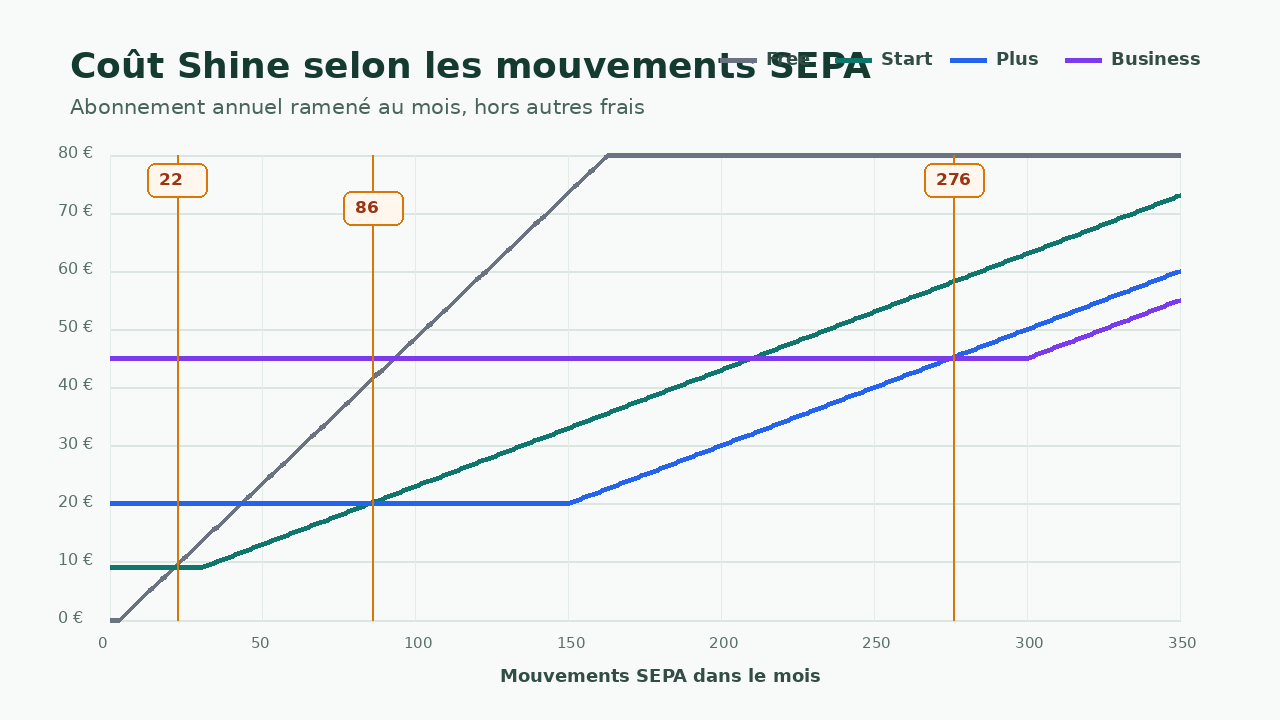
Using annual billing converted to a monthly equivalent, Start becomes cheaper than Free from 22 SEPA transactions, Plus becomes cheaper than Start from 86 transactions, then Business becomes cheaper than Plus from 276 transactions. These thresholds cover only the subscription and euro transfers or direct debits: next add team access and any other relevant charges.
Method: official Shine prices and allowances reviewed on 4 November 2026, followed by Logicelio calculations using illustrative volumes. No Shine account or real bank transaction was used.
Set out the four formulas before comparing
Since 5 October 2026, Shine has listed these prices excluding VAT: Free at €0, Start at €9 per month with annual billing or €11 monthly, Plus at €20 or €25, and Business at €45 or €60. The allowances include 3, 30, 150 and 300 monthly SEPA transactions. An additional transaction costs €0.50 on Free and €0.20 on the three paid plans.
In this calculation, a transaction means a SEPA transfer or direct debit counted within the monthly allowance described by Shine. The monthly cost limited to transactions is calculated as follows, where m is the number of transactions:
- Free = 0.50 × max(0; m − 3)
- Start annual = 9 + 0.20 × max(0; m − 30)
- Plus annual = 20 + 0.20 × max(0; m − 150)
- Business annual = 45 + 0.20 × max(0; m − 300)
Here, “annual” means that the annual commitment price has been converted to a monthly equivalent for comparison. It does not turn the commitment into a monthly plan. For billing without an annual commitment, replace only the base prices 9, 20 and 45 with 11, 25 and 60.
Reproduce the thresholds without an opaque table
Free and annual Start are equal before the Start allowance: 0.50 × (m − 3) = 9. The solution is m = 21. Both plans therefore cost €9 for 21 transactions; Start moves ahead at 22 transactions.
Between annual Start and Plus, Plus stays within its allowance while Start charges for excess transactions: 9 + 0.20 × (m − 30) = 20. The solution is m = 85. At 85 transactions, both cost €20; Plus becomes cheaper at 86.
Between annual Plus and Business, the same calculation gives 20 + 0.20 × (m − 150) = 45, so m = 275. Business becomes cheaper at 276 transactions. Above 300 transactions, both plans add the same unit cost, so the resulting gap no longer changes.
| Invoicing | Free → Start | Start → Plus | Plus → Business |
|---|---|---|---|
| Annual commitment, monthly equivalent price | Start from 22 transactions | Plus from 86 transactions | Business from 276 transactions |
| Monthly billing | Start from 26 transactions | Plus from 101 transactions | Business does not become cheaper based on transactions alone |
With monthly billing, Free and Start are equal at 25 transactions, then Start moves ahead at 26. Start and Plus are equal at 100, then Plus moves ahead at 101. Business costs €60 and Plus €25; once both allowances are exceeded, their surcharge is identical. Business therefore remains €5 more expensive than Plus on this criterion alone. Its access allowances and features may still justify the difference.
Calculate two examples before changing plans
First illustrative example: a sole trader makes 70 transactions per month and pays annually. Free would cost 0.50 × 67 = €33.50. Start would cost 9 + 0.20 × 40 = €17. Plus would remain €20 and Business €45. Start costs least on these two items, €3 less than Plus.
Second illustrative example: a small team needs 3 user accounts and makes 90 monthly transactions. Shine help states that Start includes one administrator account, Plus includes two accounts, and Business allows unlimited accounts. Additional Start and Plus accounts cost €5 excluding VAT per month.
| Supply | Subscription and transactions | Additional accounts | Calculated total |
|---|---|---|---|
| Start | 9 + (60 × 0,20) = 21 € | 2 × 5 € | €31 excluding VAT |
| Plus | 20 € | 1 × 5 € | €25 excluding VAT |
| Business | 45 € | 0 € | 45 € excluding VAT |
Plus wins this example at €25 excluding VAT. Without including user accounts, the calculation would have placed Start at €21 and produced the wrong decision. For a larger team, repeat the same addition: Business’s unlimited accounts can bring its threshold forward, but the exact volume depends on the number of users.
Collect the right data for a representative month
- Count the month’s SEPA transfers and direct debits, without mixing in card payments or international transactions.
- Record how many people need their own account and which role they will use.
- Use the annual price converted to a monthly equivalent or the monthly price according to the commitment you are actually considering.
- Apply the formulas, then add any additional user accounts.
- Add separately any cards, cash or cheque deposits, international payments and add-ons you actually use.
- Finally, compare the required features: a lower cost does not compensate for a missing feature.
Prefer three representative months to an isolated peak. Calculate each month’s cost, then review the total for the period. If your business is seasonal, also test a low and a high month: the allowance applies monthly, and an annual average can hide a one-off overage.
Exclude any plan that does not meet the need
This calculation does not compare included cards, withdrawals, deposits, payments outside the euro area, insurance or accounting support. It also does not replace a comparison of access rights. Check the pricing page when subscribing: the prices and allowances quoted were reviewed on 4 November 2026.
Free is suitable when volume remains very low and the free features are sufficient. Start becomes sensible with more transactions and one user. Plus gains the advantage for an intermediate volume or a small team. Business deserves consideration for high volume, several users or its specific features; with monthly billing, transactions alone are not enough to make it cheaper than Plus.
Do not change plans because you crossed a threshold by one transaction on one occasion. Measure the difference in euros, how often the overage occurs and the cost of a missing feature. The right choice is the one that still fits after these three checks.
Partner link
Sources and method of this analysis
Shine: plan and pricing changes since 5 October 2026 ; Shine: prices for Free, Start, Plus and Business plans ; Shine: transfer and direct debit allowances and overage charges ; Shine: included user accounts and cost of additional accounts Desk research on Shine prices applicable since 5 October 2026 and Logicelio calculations using illustrative volumes. No real account, bank transaction or payment was used. Sources consulted on 4 November 2026. Methodology · Trade transparency · Report correction.