Analysis of official documentation, with no testing on a paid account.
For a renewing subscription, a permanent virtual card is easier to track than a temporary card expiring before the next payment. In either case, list the suppliers using the card before replacing or deleting it.
Method. Shine help reviewed on 6 November 2026, with an illustrative card-cost calculation. No card was created and no payment was made.
Match the card to its use
Shine documents standard virtual cards and temporary cards expiring on a chosen date. They can be used for one-off or recurring online payments. Temporary blocking causes payment attempts to fail, while deletion is permanent.
One card per supplier can make payments easier to identify. It also creates an administrative task: each card needs an owner, an identified use and a renewal date. One shared card can remain simpler for three small subscriptions managed by the same person, provided every charge can be recognised. Separate cards may help when responsibility differs between teams or suppliers.
Count the cards’ cost
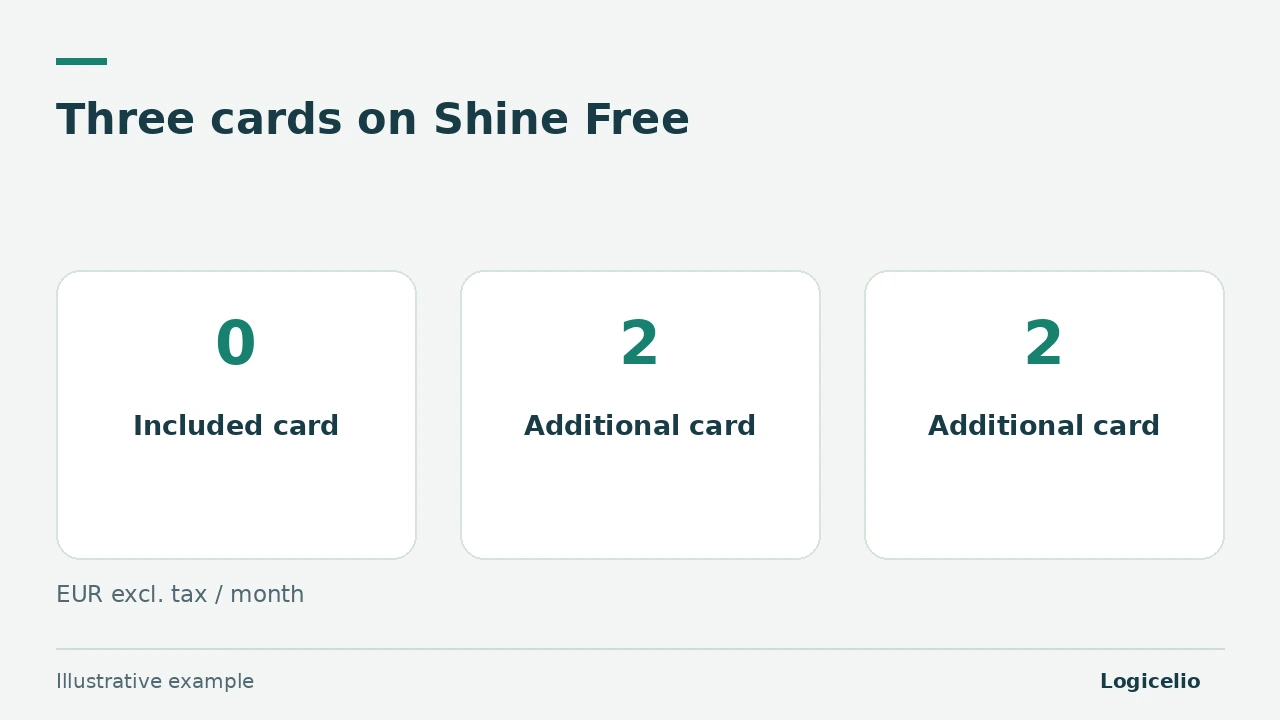
The help page states that Free includes one virtual card and charges €2 excluding VAT per month for each extra card. Start, Plus and Business advertise unlimited virtual cards without an additional card fee.
In an illustrative case, you want one card for a creative tool, one for a business subscription and one for an occasional supplier. On Free, three cards cost 0 + 2 + 2 = €4 excluding VAT per month, or €48 over twelve months if all remain active. This calculation excludes the subscription and other services or fees.
Your plan choice also depends on transaction volume, user access and other required features. The Shine plan-cost guide covers that wider comparison.
Plan a replacement
For every supplier, record the next payment date, who can update its payment method and which confirmation is expected. Change the card in the supplier’s account, check the confirmation and follow the next charge.
If a subscription is ending, track cancellation and card status as separate actions. Your management record should show both actions and their dates. A blocked card explains a declined payment; the supplier confirms the contract status.
A temporary card can suit a one-off purchase when its active period covers the intended payment. Before deleting the card, check with the supplier and Shine how a later refund would be handled.
Base the decision on three points: how long the card is needed, the cost of active cards and the person responsible for follow-up. The Shine review places those features within the wider business-account choice.
Partner link
Sources and method of this analysis
Shine: understand and use virtual cards ; Shine: plan changes since 5 October 2026 Documentary review of two official Shine pages and an illustrative Logicelio calculation. No real card, supplier account or payment was used. Sources reviewed on 6 November 2026. Methodology · Trade transparency · Report correction.