Analysis of official documentation, with no testing on a paid account.
In this guide
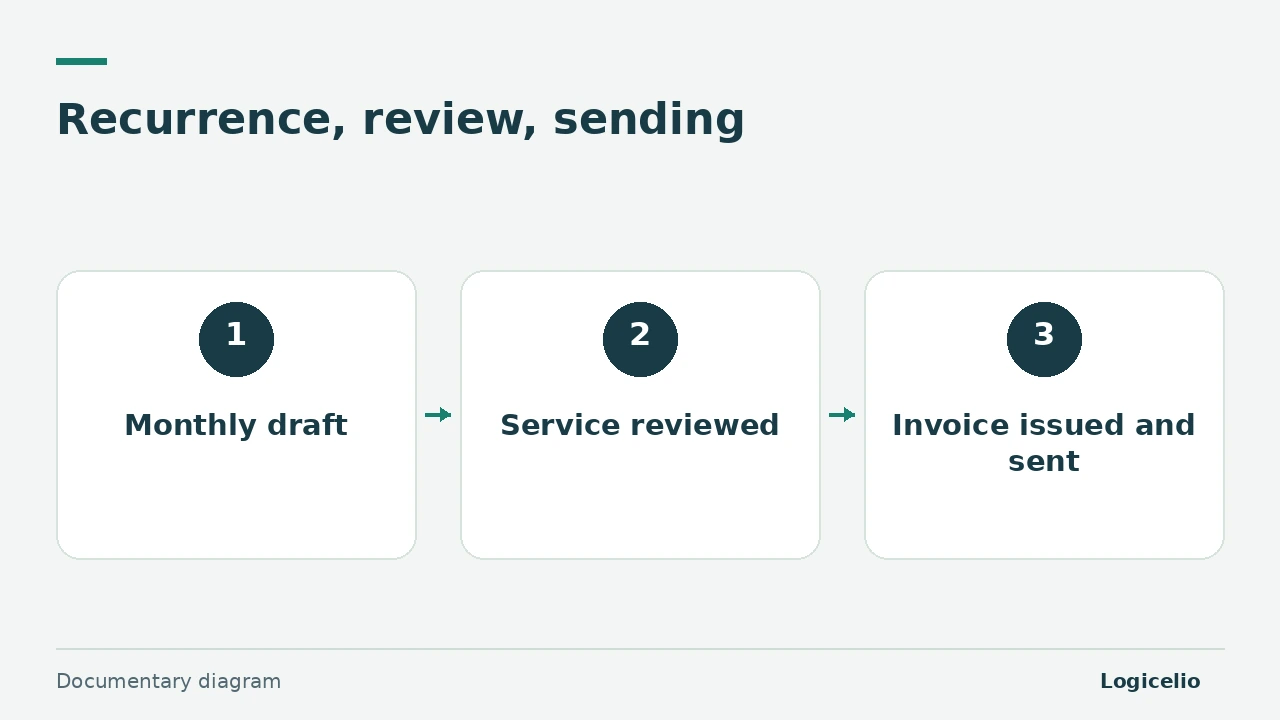
A Tiime recurrence prepares a monthly draft a few days before the planned date. It does not replace checking the service, issuing the final invoice or sending it to the customer. Add a review appointment to the schedule.
Method. Tiime help reviewed on 7 November 2026 with an illustrative billing calendar. No invoice was issued or sent.
Plan the first repeat
Tiime currently documents a monthly frequency. The first repeat occurs in the month after setup and appears as a draft awaiting review a few days before the issue date. Someone must then issue the invoice and send it to the customer.
Illustrative example: a consultant sets up recurrence on 10 November for a €300 monthly service. The first repeated invoice is expected in December. The follow-up therefore needs three checks: the draft exists, the service and amount are confirmed, and the invoice is then issued and sent.
The help pages reviewed do not identify a required plan. Check that the action is available in your workspace before building your process around it.
Keep three separate records
| Stage | Expected evidence | What it does not prove alone |
|---|---|---|
| Draft prepared | Recurrence produced a document to review | That the service and amount are approved |
| Invoice issued | The final document exists | That it was sent to the customer |
| Invoice sent | A sending record exists in the selected channel | That the invoice was paid |
In this case, two tracking lines are enough initially: “November: initial invoice sent” and “December: draft awaiting review”. Update the December line after every action. This separation identifies a missing issue before reminders begin.
Before issuing the invoice, review the billing period, customer address, purchase-order reference and agreed amount. If consumption varies, approve the quantities before finalising the document even when a monthly base provides the starting point.
Plan the final invoice
On the web, Tiime says to start from the latest relevant invoice, then use “Plus d’actions”, “Gérer la répétition” and “Désactiver”. On mobile, the procedure starts from the original invoice and also uses “Gérer la répétition” and “Désactiver”.
If the project ends in February, record the final billable period and the planned date for stopping recurrence. Then review drafts already prepared to decide whether they should be issued, corrected or discarded. Stopping future preparation and collecting earlier invoices remain separate tasks.
Choose manual preparation when it is clearer
Recurrence suits stable content and timing. If the amount, period or date changes almost every month, manual preparation may be easier to control than a draft that always needs correction.
The Tiime review places this feature within the software choice. The guide to matching a payment before a reminder covers the next stage, after issue and collection.
Partner link
Sources and method of this analysis
Tiime: create recurring invoices ; Tiime: stop recurring invoicing Documentary review of two Tiime help pages and an illustrative €300 billing calendar. No real invoice was issued or sent. Sources reviewed on 7 November 2026. Methodology · Trade transparency · Report correction.