
Is Descript worth considering?
Yes if you recognize yourself here: podcasters and spoken video creators. Audio and video editing based on text. Less indicated for: highly advanced post-production cinema projects. In this case, look at an alternative of the same category.
In this review
Descript at a glance
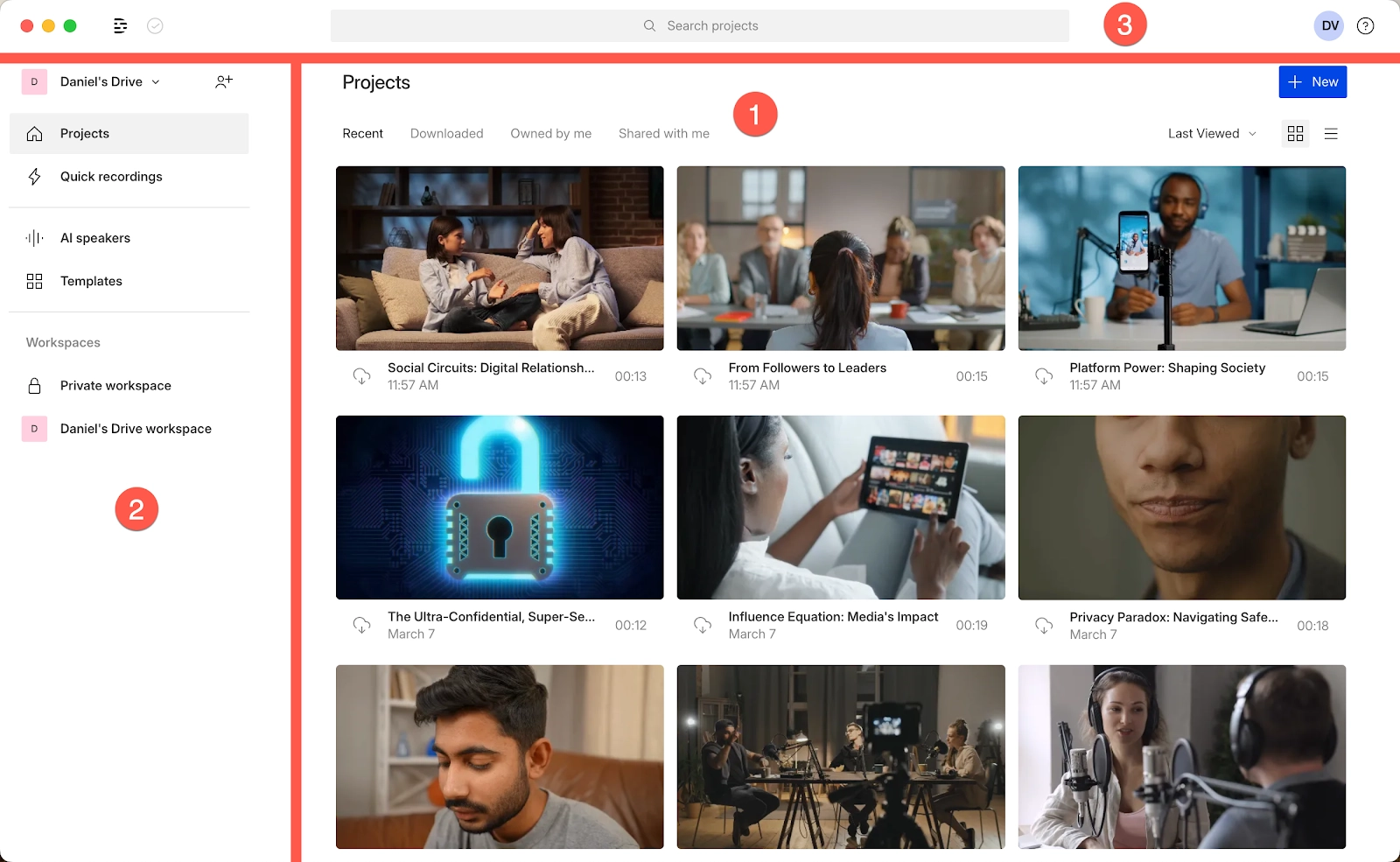
Official visual of Descript: what it represents
Descript Drive View presented in the official tutorial updated in July 2026. This is an official product visual, distinct from an interface screenshot. Logicelio relates it to the product’s positioning, “Text-based audio and video editing”, and to these features: transcription, editing through text, and AI audio and video tools. It makes no claims about elements that are not visible in the image.
The visual comes from an official Descript resource.
View Descript on the official website →
What to remember before choosing Descript
Descript deserves a try when the speech structure the content: interview, course or podcast. Editing from the text can help identify passages, but you have to listen to the result to keep the meaning and transitions. The budget must cover imported media and AI operations, not only the final published duration.
Price checked on 26 September 2026; check the current price before choosing.
Original test title: Descript audio and podcast platform review
What Descript offers on a daily basis
The help documentation distinguishes media duration from credits consumed by AI features. A short episode may start with a long recording and several attempts. Estimate the volume of source material and the corrections needed before calculating the cost of your monthly production schedule.
A correct cut in the transcript can create a sound rupture or change the context of a sentence. Reread the names, numbers and technical terms, and then listen to the connections. A transcription error can become a editing error if it is not detected.
Descript includes Studio Sound among its features. Compare the result on a representative clip and keep the source. Processing that helps a voice recorded in a noisy room may need different settings for music or multiple speakers.
The documentation distinguishes plans from top-ups of minutes or credits. Check whether these extras are available with your plan and what happens when the quota is reached. Your publishing schedule must accommodate the risk of hitting a limit.
When this option makes sense
Who it is for: creators of interviews, podcasts and spoken content.
When to look at another approach: Old transcription hours do not necessarily describe current plans. The documentation now distinguishes minutes media and credits AI.
A podcast recorded every week
The choice depends on the correction time and the volume of sources, not just the number of episodes. Descript is relevant to compare whether the content is mainly spoken and whether the team maintains an audio validation before publication.
Price: what you really need to budget
Limits that may change your mind
Older transcription-hour allowances no longer necessarily describe current plans. The documentation now distinguishes media minutes from AI credits. The help documentation distinguishes media duration from credits consumed by AI features. A short episode may start with a long recording and several attempts. Estimate the volume of source material and the corrections needed before calculating the cost of your monthly production schedule.
Three checks to see if Descript suits you
Transform an internal interview into a short excerpt without distorting the speaker's speech.
- Choose a difficult extract
Include proper names, hesitations and two voices to assess the correction required.
- Listen to the cups
Check the direction, connections and timing after each major change.
- Lifting meters
Compare source duration, final duration and credits consumed, then extrapolate to your calendar.
What TechRadar actually tested
This test was carried out by TechRadar, not by Logicelio. I cite it to provide a perspective based on actual use, without adopting its verdict as my own.
Old Source: this test dates from the 7 October 2021 and exceeds the editorial threshold of 24 months. The product may have evolved.
The protocol announced: Practical testing of transcription, audio editing and podcast production functions.
The test highlights an accessible and integrated editing workflow, but notes an imperfect transcription and historical limitations on some advanced functions.
Read the original test on TechRadar ↗Descript facing the closest solutions
| Software | Positioning | Profile | Cost to watch |
|---|---|---|---|
| Descript this review | Audio and video editing based on transcription | creators of interviews, podcasts and spoken content | media processed, credits AI and production access |
| InVideo | Video creation assisted by AI and content editing | creators who want to produce variants by controlling their generation budget | models, duration, actors and operations consuming credit |
| VEED | Online video creation and editing with captioning and tools AI | teams that produce short videos and social declinations | accesses, AI functions, captioning and export quality |
| Wondershare Filmora | Accessible video editing with assisted creation features | Self-employed professionals and small teams producing videos, tutorials and social content | Subscription, renewal, AI credits and rights to resources |
See all alternatives to Descript →
Scope of the documentation
Interface language: incomplete documentary verification.
Sources used for this review
Documentary review of 27 September 2026. No transcription rate, time saved or audio quality measured by Logicelio.