Analysis of official documentation, with no testing on a paid account.
Electronic invoices: check receipt in September
Literature review · Accessible sources and methodology
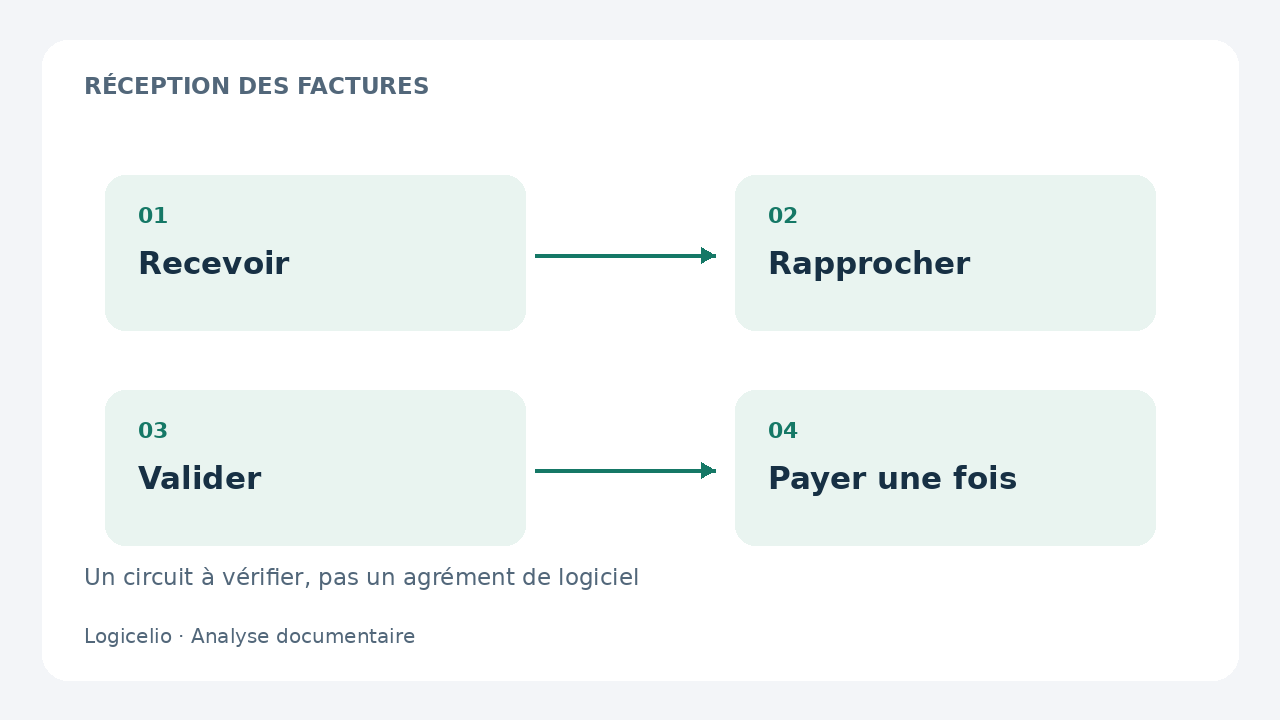
The first deadline has passed. For a small business affected by the reform, the useful question is no longer just “Which software should we choose?”, but “Where does a supplier invoice arrive, who sees it and how do we avoid paying it twice?” Here is a checklist to use with your provider or accountant.
Reception in 2026, small business issue in 2027
In its official point of the 1er September 2026, Bercy confirms the entry into force of the reception by an approved platform for the undertakings concerned. Issue becomes mandatory for large companies and ITEs at this time; micro-enterprises, small businesses and SMEs have the maturity of the 1 September 2027 for the issue.
Waiting until 2027 to address invoice receipt therefore confuses two obligations. Conversely, receiving an electronic invoice does not mean that all your own invoices must already be issued through the same route. The scope depends in particular on your activity, customers and VAT situation. The Official DGFiP questionnaire allows to specify your case; it also provides for special situations and companies of the DOM/COM.
1 Control: Identify the point of arrival
A contract signed with software is not enough to make the circuit intelligible to the team. Ask for the exact name of the receiving platform and how your solution is connected to it. Keep the answer with the information of the company concerned. A company and another company of the same officer must not be confused in the file.
Our operational advice: create a one-page internal reference with three fields: “designated platform”, “person who checks invoices” and “contact if something is blocked”. It is especially useful during an absence: the replacement should know where to look without retrieving all the sales correspondence.
To distinguish the role of software from that of the platform, consult our explanation of approved platforms and compatible solutions. Do not deduct the approval of a mark from the mere presence of the word "compatible" on a commercial page.
2 control: linking receipt, validation and payment
Choose an invoice received as part of your activity, then follow his/her path with the person who treats him/her. The aim is not to create a false bill to check a box. It is to verify that an invoice received can be found, reconciled with its supplier, forwarded to the correct contact person and followed up until it is processed.
| Question | Useful trace to keep | Interlocutor |
|---|---|---|
| Where did the bill arrive? | Reference, date and channel of receipt | Provider or administrative manager |
| Who needs to validate it? | Appointed official and internal circuit | Head or Head of Purchase |
| Has she ever been treated? | Accounting reference and payment statement | Accountant or settlement person |
A tracking chart does not replace your accounting records. It is used to identify the passage where information is lost. If the invoice is visible on the platform but is missing from the management software, formulate the problem with the support: this makes it possible to distinguish an incident of reception from an integration incident.
3 control: recognize the same invoice on two channels
The DGFiP start-up guide specify that an invoice received by mail, PDF or paper should not be excluded for this reason alone if it corresponds to a real transaction and contains the necessary elements. Regularization of the circuit must not result in double payment or double accounting. Continuity of processing is not a compliance exemption.
To organise this check, match the supplier, invoice number, date and amount before creating a new entry. A different filename does not prove it is a different invoice. If the match remains unclear, keep the document pending clarification from the supplier or accountant instead of guessing the relationship between two documents.
In case of start-up difficulty, document the incident and correction procedures. DGFiP explains that its support of companies engaged in serious compliance does not constitute a deferral or suspension of the obligation. Therefore, a starting tolerance should not be transformed into an alternative calendar.
Change software only if necessary
Before a migration, ask your provider if the missing path can be activated in your current configuration. Then compare the full cost: reception, future issue, users, export and support. A free offer on one function can leave another step out of perimeter.
Our guide to reform sets the long-term benchmarks. The comparative Indy, Tiime and Qonto then helps to distinguish between uses. The Tiime review details the perimeter of this software and refers to its sources. This article deals with the organization after startup; it does not certify the compliance of any software or business file.
This literature review is based on the administrative publications cited. Use the grid to prepare your own checks. For a particular territorial case, exemption or transaction, have your accountant or administration confirm the perimeter.
Sources and transparency
Bercy, kick-off of the 1er september 2026 ; DGFiP, practical start-up guide ; DGFiP, questionnaire according to company situation ; Tiime, official website for software context Sources consulted on 28 September 2026. Methodology · Trade transparency · Error reporting.
Editorial history
28 September 2026: initial publication. Dates are changed only after substantial changes in content.